An Unruly Kingdom: Religion and Revolution
in the British Atlantic World
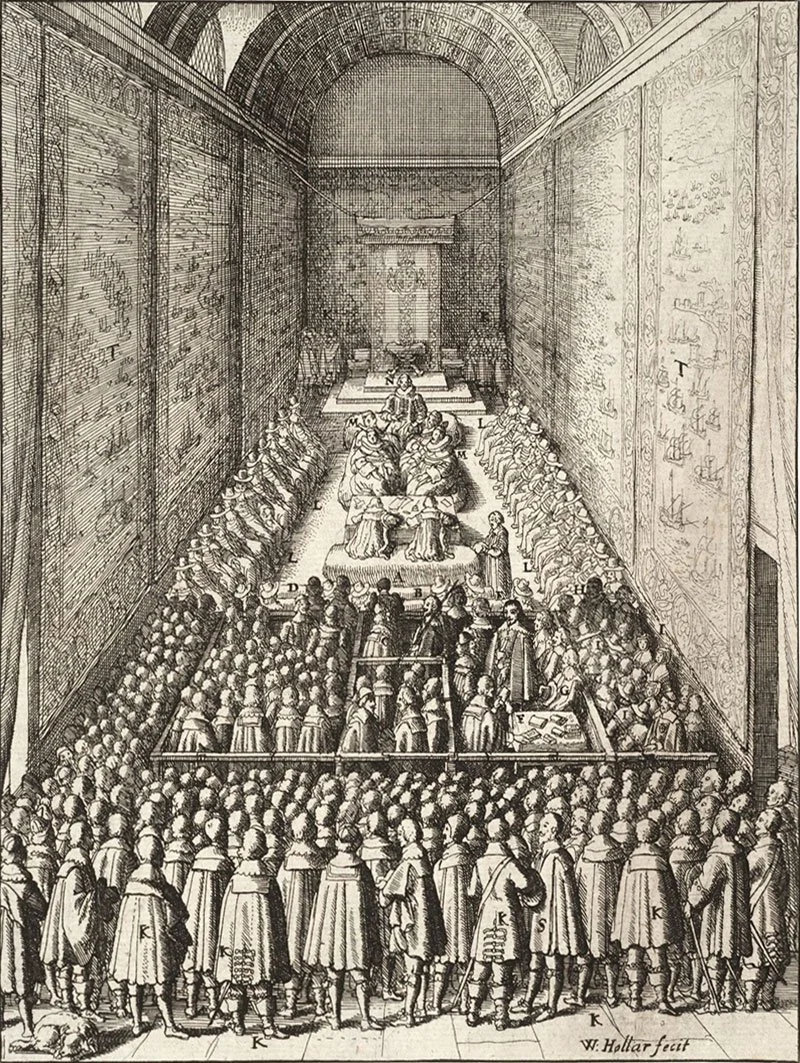
The trial of Archbishop William Laud,
who was executed in 1645.
Coming in 2027!
An Unruly Kingdom traces three centuries of religious conflict—from the court of Queen Elizabeth I in the 1560s to the backwoods of Virginia in the 1780s—and explains, in a compelling way, why the United States became the first nation in history to constitutionally separate church from state.
The question at the center of An Unruly Kingdom is one that Americans are grappling with today, in school board meetings and Supreme Court oral arguments and state legislatures across the country: How did a deeply religious nation come to insist that religion and government be kept apart? The standard answer—the Enlightenment, Jefferson, Madison, the First Amendment—is not wrong. But it is incomplete. The real answer is older, bloodier, and far more instructive. It begins not in Philadelphia but in Lambeth Palace, with an archbishop who believed, with perfect sincerity, that forcing his subjects to conform to a single faith was an act of mercy.
More than is known, the story this book tells is the history of that archbishop—and of all the archbishops, monarchs, dissenters, lawyers, theologians, preachers, satirists, and revolutionaries who came before and after him. It is a story of how a state church spent three centuries trying to impose religious uniformity, failing virtually every time, and gradually—grudgingly—learning that coercion was not the answer. It is a story of iron conviction colliding with human stubbornness. And it is, ultimately, a story about the birth of liberty of conscience: how a radical idea that once got people killed became, by 1790, the foundational principle of American constitutional democracy.
The book is organized into three acts. Part One (The Tumult of the Tudors) covers 1560–1603. Part Two (Uncivil Wars in Stuart and Williamite England) covers 1603–1717, following religious conflict to its catastrophic climax in civil war and regicide. Part Three (The Crisis of Conformity in America) covers 1630–1786, tracing how this turbulent British history crossed the Atlantic and shaped the religious landscape of colonial North America—from Puritan New England to Anglican Virginia to the revolutionary crisis that made the First Amendment not just possible but necessary.
The central irony—and the book’s most powerful argument—is this: the Crown’s relentless pursuit of religious unity produced not peace but war. Every archbishop who cracked down on dissent created more dissenters. By the time James Madison drafted the First Amendment, he was not inventing a new idea. He was codifying a lesson the English-speaking world had spent three centuries learning the hard way.